

European Sleeper will add a new night train linking Brussels and Amsterdam with Switzerland and Milan from June 2026. The service will run three times a week and follow the Simplon route via Bern, Brig, Domodossola and Stresa — establishing a direct overnight connection into northern Italy.
The new line follows the launch of the Paris–Berlin service in March 2026. European Sleeper plans to run direct coaches from both Brussels and Amsterdam, splitting and combining the train in western Germany to secure suitable departure times from all three northern cities. Services from the north will run on Monday, Thursday and Saturday evenings, with returns from Milan on Wednesday, Friday and Sunday nights. Ticket sales are expected to open in early 2026.
Split operations and an Alpine crossing
Splitting and recombining the train en route is key to offering workable timings from Amsterdam and Brussels while operating a single formation south of Germany. Overnight paths through Switzerland and into Italy are tight, and operators must secure slots early to avoid conflicts with freight and maintenance work.
The train runs along the Simplon axis, entering Switzerland via Bern and continuing through Brig and Domodossola before descending towards Stresa on Lago Maggiore. The route carries dense freight and international passenger flows and provides a stable, low-gradient passage into northern Italy.
A network built around large European cities
Since launching in 2023, European Sleeper has carried around 240,000 passengers on more than 750 night trains. The operator will add a second service — Paris–Berlin — in March 2026. The Milan line becomes the third long-distance connection and extends the network further south into Italy’s main economic region.
The Milan service means the planned Barcelona line will not launch in 2026. Preparations continue, with operations expected in 2027 or 2028 depending on rolling-stock availability and pathing.
Cross-border timetable work under way
Timetable coordination with infrastructure managers in Belgium, Germany, Switzerland and Italy continues. Night trains must fit around maintenance windows, engineering works and busy daytime traffic. The Simplon crossing adds another layer, as tunnel access and seasonal engineering schedules influence reliability.
European Sleeper plans to offer the same range of comfort classes as on its existing routes, with similar pricing.
A fragile market with gaps and cancellations
Recent developments underline how sensitive Europe’s night-train market remains.
1. Basel–Malmö will not launch. The planned route has been halted after Swiss political support fell away, ending the project before operations began. It follows a pattern seen elsewhere, where long-distance night trains struggle when they rely on short-term subsidies, ageing rolling stock or limited network capacity.
2. Similar pressures affect other international services. Several recent cross-border proposals have faced the same structural constraints: fleets that are difficult to scale, inconsistent national support, and competition for overnight paths on congested sections of the network.
3. The Brussels–Amsterdam–Milan line has operational constraints. The Simplon axis currently faces engineering works on the Swiss–Italian crossing, reduced capacity around Bern during station redevelopment, and seasonal maintenance windows. These factors do not prevent operation, but they shape how robust a long north–south service can be — and how tightly its timetable is tied to infrastructure availability.
Why it matters: The service adds a long north–south night-train link through one of Europe’s busiest Alpine rail axes, showing that multi-origin services are possible when operators secure paths, rolling stock and cross-border coordination.
What’s next: Finalising timetable slots and opening ticket sales in early 2026 will test demand and confirm whether split operations and the Simplon routing can support consistent overnight services.
Simplon Tunnel – the Alpine link shaping European rail
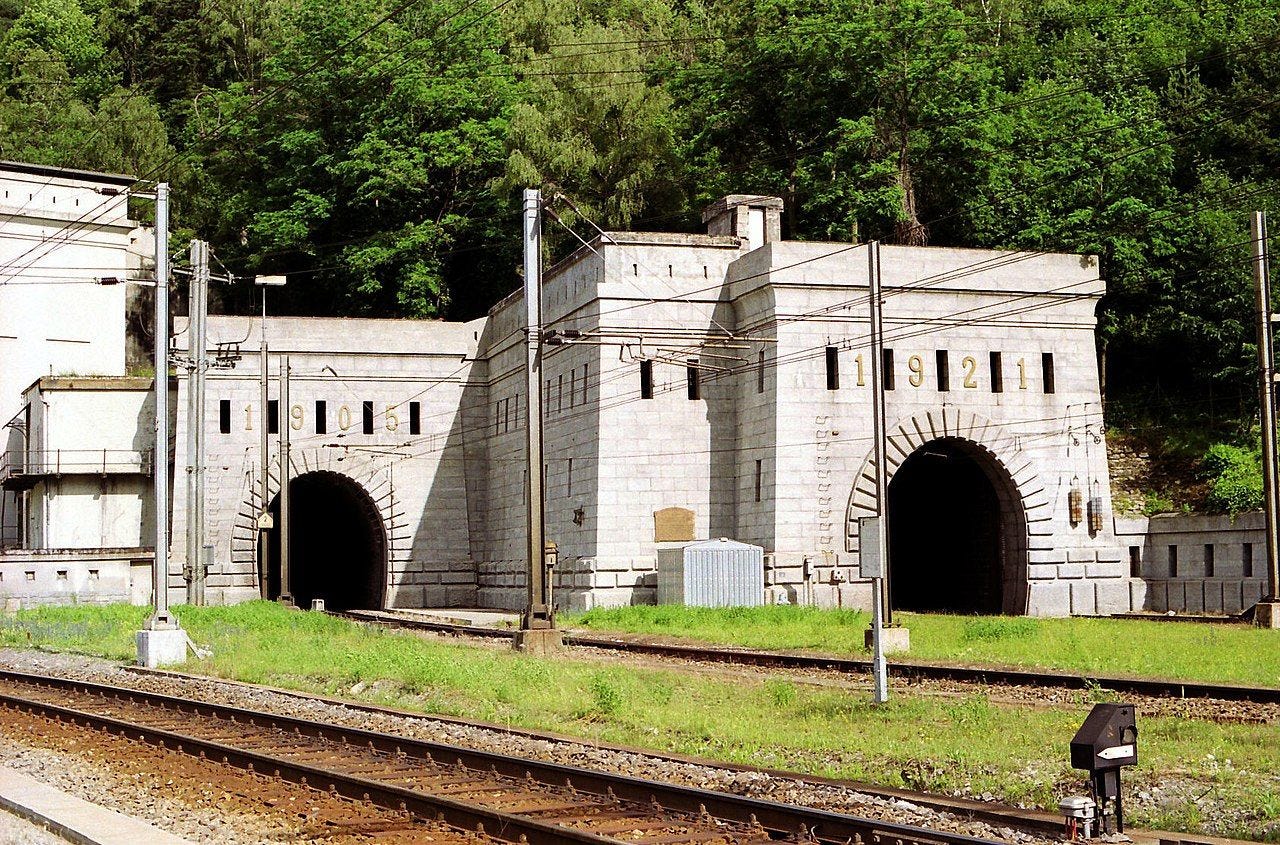
Opened in 1906 and expanded with a second tube in 1921, the 19.8 km Simplon Tunnel connects Brig in Switzerland with Domodossola in Italy.
It created a low-gradient, all-weather rail passage under the Simplon Pass, shifting long-distance traffic away from steeper Alpine routes.
The axis later carried major international services — including the Simplon-Orient-Express — and remains a central link for freight and passenger flows.