

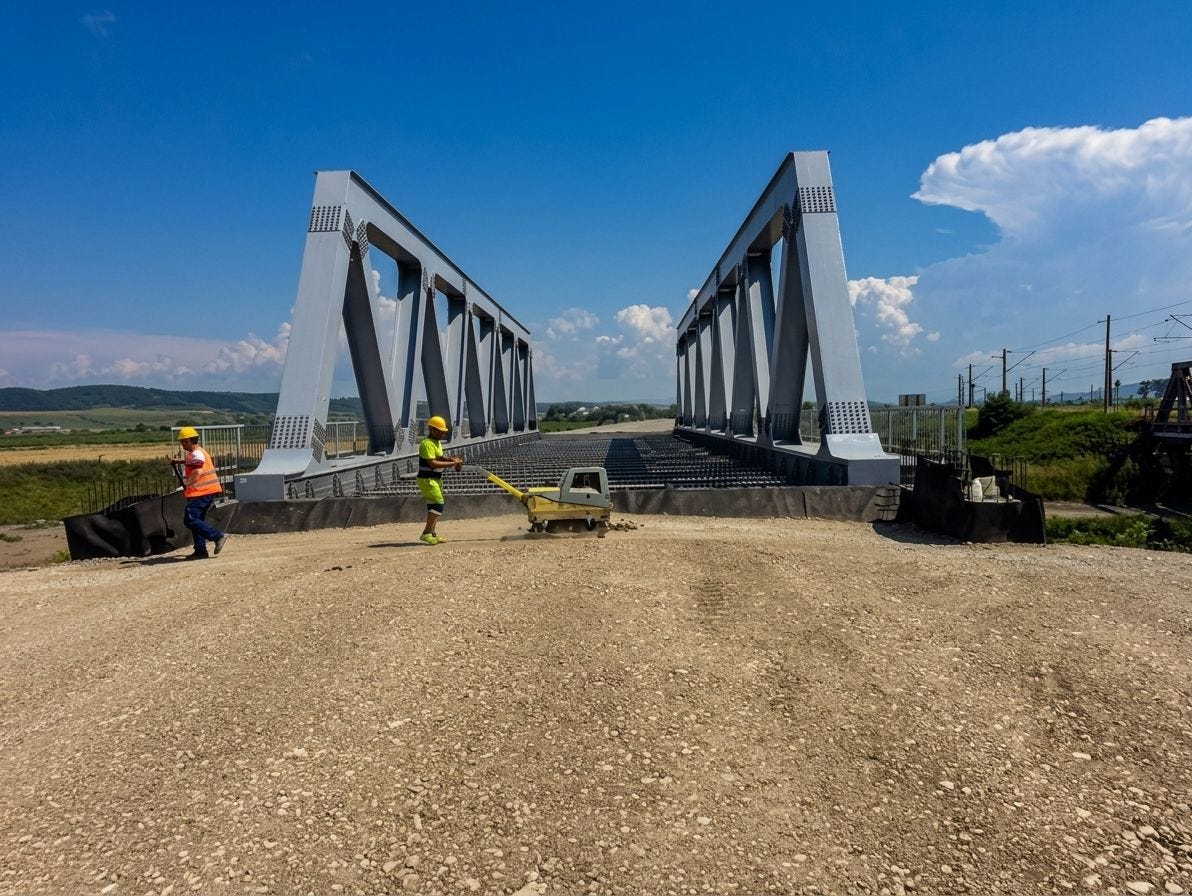
ROMANIA: The European Investment Bank (EIB) has signed a EUR 630m loan with Romania for the upgrade of the 113 km Brașov–Sighișoara line. Construction began in 2020, and infrastructure manager CFR SA’s own report puts it at 60% complete, with both contracts now due in 2028.
Finance Minister Alexandru Nazare signed the agreement in Bucharest on 4 September, and the EIB countersigned in Luxembourg on 9 September. The bank announced the deal on 14 September. The total project cost is estimated at EUR 2.25bn, to be covered by the loan, EU funds and the state budget.
The line lies on the Rhine–Danube and Baltic–Black Sea–Aegean corridors of the Trans-European Transport Network (TEN-T). The project is split into three sections under two construction contracts, all of which started in 2020. A year ago, the Romanian infrastructure manager expected work on the middle section to finish in October 2026.
What the upgrade delivers
After the upgrade, passenger trains are to run at 160 km/h and freight trains at 120 km/h, with capacity for up to 29 passenger and 22 freight trains a day. The EIB expects around 4 million passengers and 6 million tonnes of freight a year. The line will take longer and heavier freight trains and be fitted with the European Rail Traffic Management System (ERTMS).
“This is an investment in people, connectivity and Romania’s future,” EIB Vice-President Ioannis Tsakiris said.
Romania’s finance ministry said the loan, with a maturity of up to 27 years, will cover the national co-financing from the state budget. The bank’s advisory arm assisted the Romanian authorities in preparing the project.
Three sections, one status report
The 28 km middle section between Apața and Cața, built under a contract led by Greek contractor Aktor, stood at 60.27% physical progress in July with completion scheduled for February 2028, according to the infrastructure manager’s latest status report. The two outer sections, 84 km in total, were at 60.12% with a June 2028 deadline. They are built by the RailWorks consortium of Alstom, Aktor, Arcada Company and Euro Construct.
In October 2025, the same reporting put the middle section at October 2026 and the outer sections at April 2027. The outer sections include the Archița and Beia tunnels, where progress has been uneven.
Two tunnels and the old line
The middle section includes twin-bore tunnels at Ormeniș and Homorod, 6.9 km and 5.1 km long, which will be the longest rail tunnels in Romania. Both are being built under the Aktor-led contract.
Infrastructure watchdog Pro Infrastructură said in July that the new line will not be ready before 2030. It recommended repairing around 40 km of the existing line between Apața and Cața in the meantime.
Grants before the loan
Grants from the EU’s Connecting Europe Facility (CEF) in the 2014 and 2015 funding rounds, totalling roughly EUR 1.2bn, co-financed the two outer sections. The EIB describes its loan as sitting alongside EU funds and the state contribution.
The finance ministry said the project will continue to receive grants from the Transport Programme 2021–2027, Romania’s EU-funded transport programme. The ministry expects the project to be completed in 2029.