

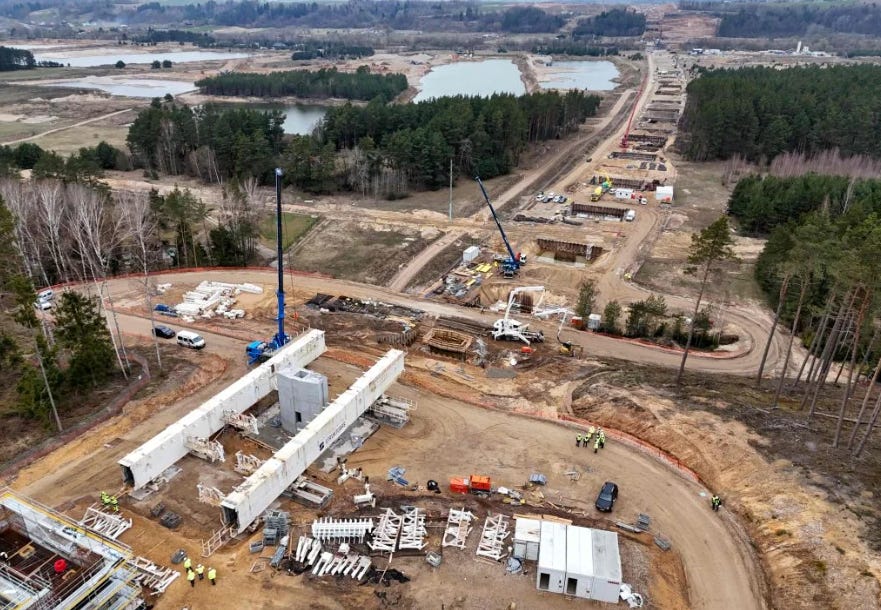
The construction of an 870-kilometre standard-gauge corridor linking the Baltic states to Poland represents the EU’s most complex cross-border infrastructure delivery challenge.
Rail Baltica connects Warsaw to Tallinn via Kaunas and Riga — entirely new 1,435 mm gauge track designed for passenger speeds up to 249 km/h and freight loads of 25 tonnes per axle. The project replaces the Soviet-era 1,520 mm gauge that still isolates Baltic rail networks from the rest of Europe.
Co-financed through the Connecting Europe Facility, the line is being coordinated by RB Rail AS alongside three national infrastructure managers: LTG Infra in Lithuania, Edzus Dzelzceļš in Latvia, and Eesti Raudtee in Estonia.
Construction advances across three countries
Lithuania has moved most rapidly, with over 100 kilometres under active construction. Latvia is advancing station works near Riga and preparing cross-country procurement packages. Estonia has broken ground on the Ülemiste multimodal hub in Tallinn. Across all three countries, roughly 43 percent of the corridor has reached construction-ready status.
System integration presents the greater challenge. The EUR 1.77 billion electrification package covers the entire route with 2×25 kV AC 50 Hz supply. ERTMS deployment and tracklaying packages continue through procurement, requiring coordination of standards, interfaces, and commissioning schedules across three national bodies.
Our Quick Analysis
Rail Baltica’s delivery model will influence future TEN-T cross-border projects. The staged approach — single-track sections opening first, full double-track following later — reduces upfront costs but complicates early operations. Success depends less on engineering than on whether three national organisations can function as an integrated delivery unit. Fragmentation in standards or commissioning could push the target timeline from the late 2020s into the mid-2030s.