

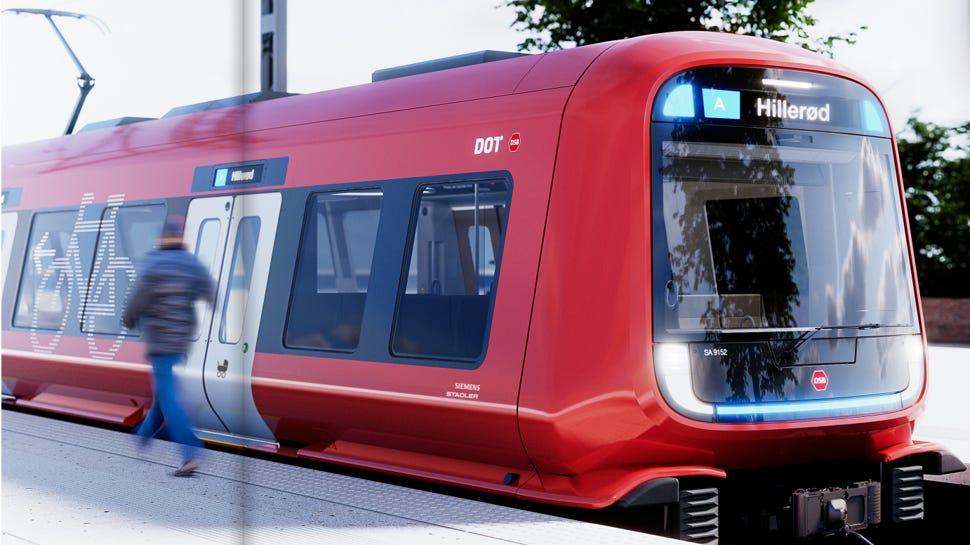
Danish State Railways (DSB) has awarded a contract for at least 226 new commuter trains for Copenhagen’s S-Bane network to a Siemens Mobility–Stadler consortium. The trains form part of DSB’s programme to introduce fully automated, driverless operation.
The contract is valued at DKr 23 billion (around EUR 3.1 billion) and includes a 30-year maintenance agreement. The consortium is responsible for the maintenance programme, while DSB staff will perform the day-to-day maintenance.
Fleet renewal and automation programme
DSB expects the first new trains to enter service in 2032, with the initial deployment planned on Line F between København Syd and Hellerup. The operator’s latest timeline points to fully automated, driverless operation across the network by around 2040.
In 2024, the S-train network carried 112 million passenger journeys. DSB expects demand to continue rising.
Train design and service frequency targets
DSB’s reference specification describes 56 m-long four-car trainsets with 156 seats, level boarding, and a maximum speed of up to 120 km/h. DSB says the interior will include features such as a mix of 2+2 seating, air conditioning, work areas with tables, and integrated wheelchair spaces.
DSB says full automation is expected to support peak headways of up to 7 minutes 30 seconds on each line, and down to 1 minute 30 seconds on the central section. On some sections, DSB estimates this would allow up to 35% more departures than today. DSB estimates the higher frequency could also enable around 10 million additional passenger journeys per year.
Why it matters: DSB has set quantified headway and capacity targets for the S-Bane. The fleet order is therefore tied to an operational plan, not only a rolling-stock renewal.