

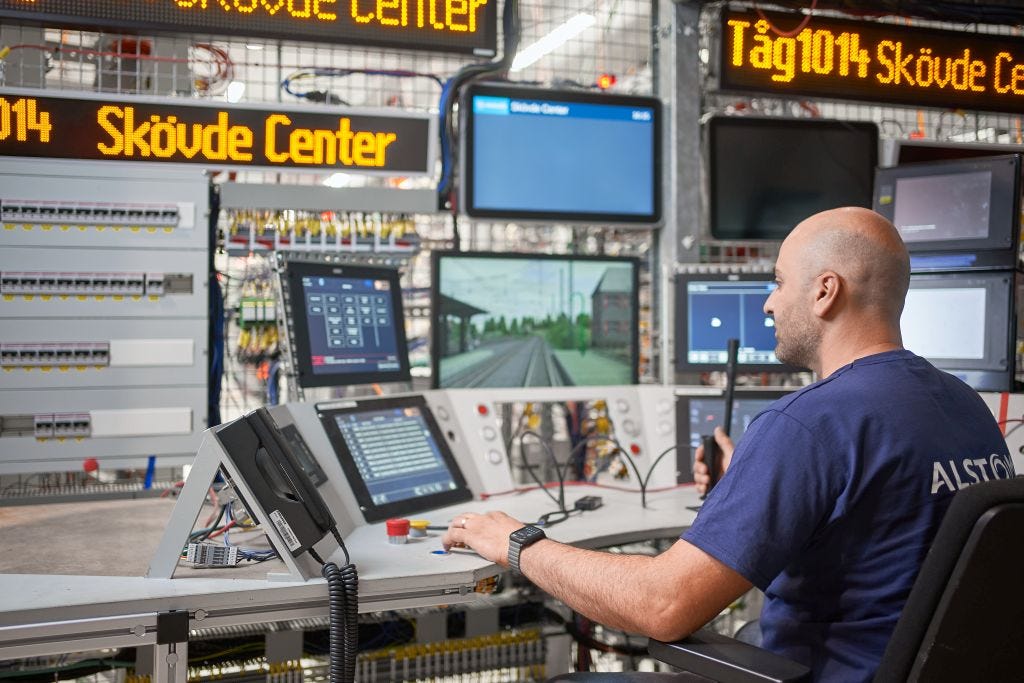
Digital systems increasingly govern the operational core of European rail — managing fleets, monitoring assets, automating decisions, and carrying the traffic data on which safety and capacity depend.
Digitalisation in rail is not primarily a passenger-facing story. The systems that matter operationally are those managing train movements, monitoring rolling stock condition, scheduling maintenance, and connecting trains to control centres.
The digital stack
The digital stack runs from fleet management systems at the top — the operator’s real-time picture of train locations and performance — down through asset management, predictive maintenance, and planning and traffic management tools, to embedded sensors and onboard control systems at the base.
Asset management software tracks component condition and history across full lifecycles. Predictive maintenance platforms analyse sensor data to flag failure risk before a component fails.
Planning tools, traffic management systems, and machine learning applications sit alongside these operational layers, optimising scheduling, energy use, and delay recovery.
Automating the driving task
Automatic Train Operation (ATO) automates driving within defined parameters and can tighten headways beyond what manual driving allows.
Germany’s Digital Rail Germany programme combines ATO with the European Train Control System (ETCS) and digital interlockings. Deutsche Bahn targets a capacity increase of up to 35% on existing infrastructure without building a single additional metre of track.
Data fragmentation across networks
European rail runs across dozens of national networks and hundreds of operators, with fleets built over decades on incompatible data architectures. A train crossing three countries may generate operational data in three formats that no single system reads in real time.
Much of Europe’s signalling and control infrastructure was designed before interoperability became a design criterion. Retrofitting data connectivity onto existing fleets and trackside equipment is technically feasible but expensive.
Data therefore exists in volume — modern rolling stock generates sensor data continuously — but sits siloed within individual operators, maintenance depots, or national networks.
EU-Rail’s September 2024 assessment of its Optimised Track System technology demonstrator found the combined package of track and maintenance technologies tested has the potential to improve reliability and punctuality by 20–30%, alongside a comparable capacity gain, through reduced unplanned maintenance and service disruption.
Achieving comparable gains from predictive maintenance specifically depends on data that is consistent, accessible, and well-labelled — a baseline many operators have not yet reached.
Investment and regulation
Europe’s Rail Joint Undertaking (EU-Rail), established under Horizon Europe as successor to the Shift2Rail initiative, is the primary EU-funded vehicle for rail digitalisation research and innovation. Its 2021–2027 budget totals EUR 1.2 billion, split evenly between EU funding and contributions from its private members.
EU-Rail’s Governing Board adopted its high-level policy paper on 24 June 2025, calling for EUR 18 billion in combined public and private investment from 2028 to 2034. Of this, EUR 3 billion is earmarked for research and innovation and EUR 15 billion for pre-deployment of harmonised technologies — described by the paper as a strategy for European technological sovereignty.
Cybersecurity has become a mandatory dimension of rail digitalisation. The EU’s NIS2 Directive (Directive 2022/2555) entered into force in January 2023, with a Member State transposition deadline of October 2024.
Railway undertakings and infrastructure managers fall within its Annex I sectors; whether a given operator is classed as an essential or an important entity depends on its size, with only those above the medium-sized threshold treated as essential.
The validation bottleneck
Safety approval is the bottleneck. Digital systems that touch train movements must be validated before they enter service, and the standards for software-driven safety functions are still being written. Until they are, deployment lags behind what the technology can already do.
Go deeper:
Fleet management systems
Asset management and lifecycle software
Predictive maintenance platforms
Digital twin technology
Cybersecurity for rail