

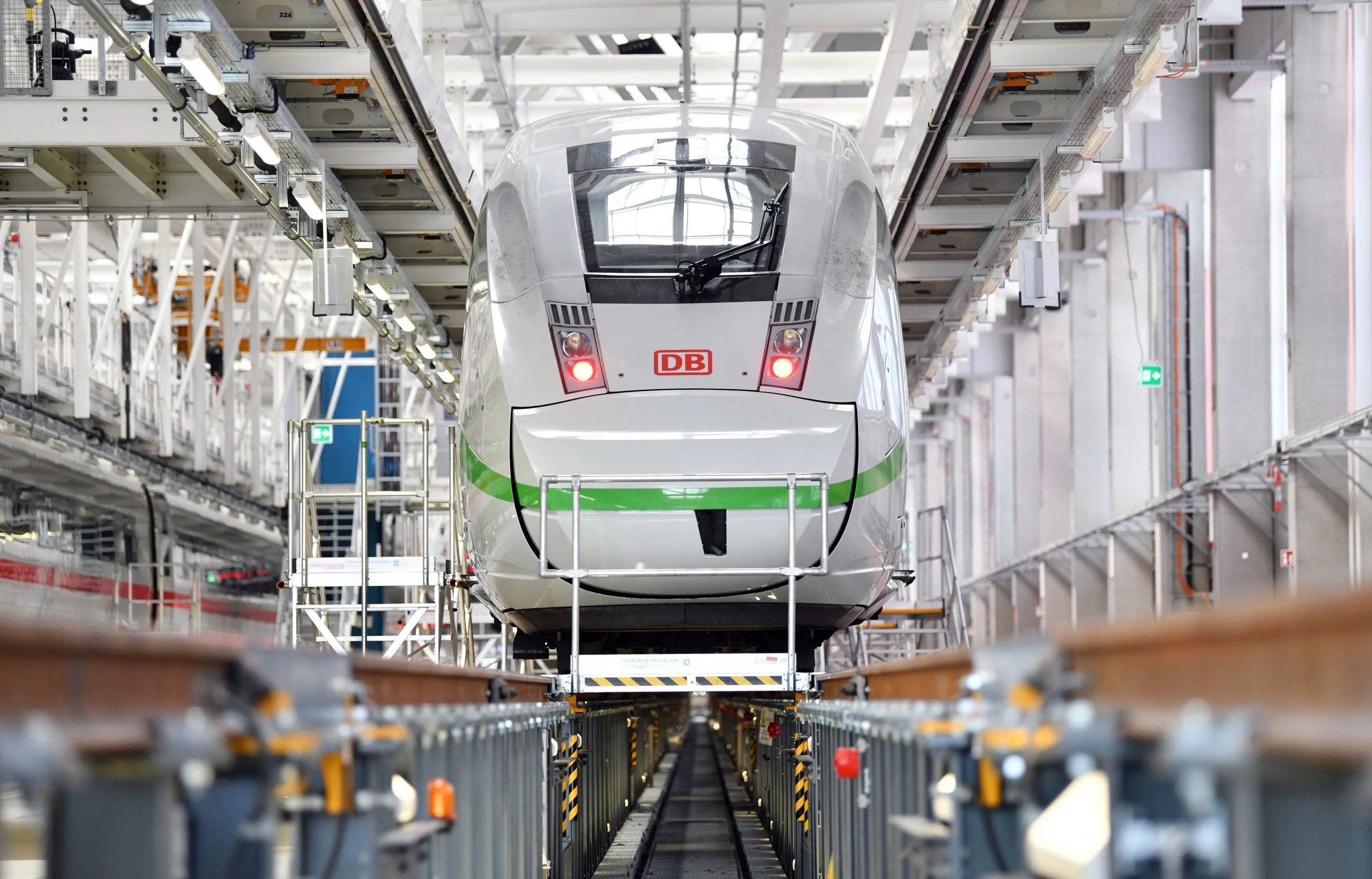
Deutsche Bahn and Siemens have begun testing remote control of ICE 4 trains in depot environments as part of Germany’s RemODtrAIn project. The work aims to automate short shunting, stabling and preparation runs using 5G communication and AI-supported obstacle detection — a practical step toward digitalising depot operations.
Tests are under way at the ICE depot in Cologne-Nippes and at Annaberg-Buchholz, where ICE 4 and Desiro units are being equipped with new communication and sensor systems. The consortium of twelve partners builds on earlier work in AutomatedTrain and safe.trAIn, supported by EUR 17 million in funding. Initial validation is planned through 2028, with an architecture designed for retrofit use on existing and regional fleets.
Why depots are the natural testbed for automation
Depots offer controlled conditions, short movements and immediate operational benefits. For DB, remote control targets time-critical shunting at the start and end of service days, when staff availability is limited and preparation bottlenecks are most acute.
In RemODtrAIn, the driver moves from the cab to a control room, where shunting and stabling can be handled from a single workstation. This shift in tasks is intended to reduce waiting times and streamline preparation flows for long-distance services.
The technology: 5G, AI and a safety-critical architecture
The project is developing a modular safety architecture that combines 5G connectivity with AI-based obstacle detection. Cameras and sensors feed data into a support system that identifies objects ahead of the train. Public 5G networks are being tested both in depots and at the Smart Rail Connectivity Campus, while S-Bahn Berlin will validate obstacle detection in daily operations. Satellite connectivity is also part of the long-term design.
Why it matters: Reliable depot-level automation could help operators address pressing issues such as staff shortages, capacity limits and preparation delays. Demonstrating this in controlled environments lays a realistic foundation for broader automation in train operations.
Really sharp analysis of how DB is approaching depot automation pragmaticaly. The shunting bottleneck during peak prep times is such an underrated constraint, and using depots as the proving ground before mainline applications makes sense both technically and from a risk management standpoint. What caught my eye is the modular retrofitarchitecture, that could give DB serious flexibility to test different sensor configurations without committing to a single vendor stack. If the 5G reliability holds up in the Cologne enviroment, this could accelerate rollout timelines significantly.