

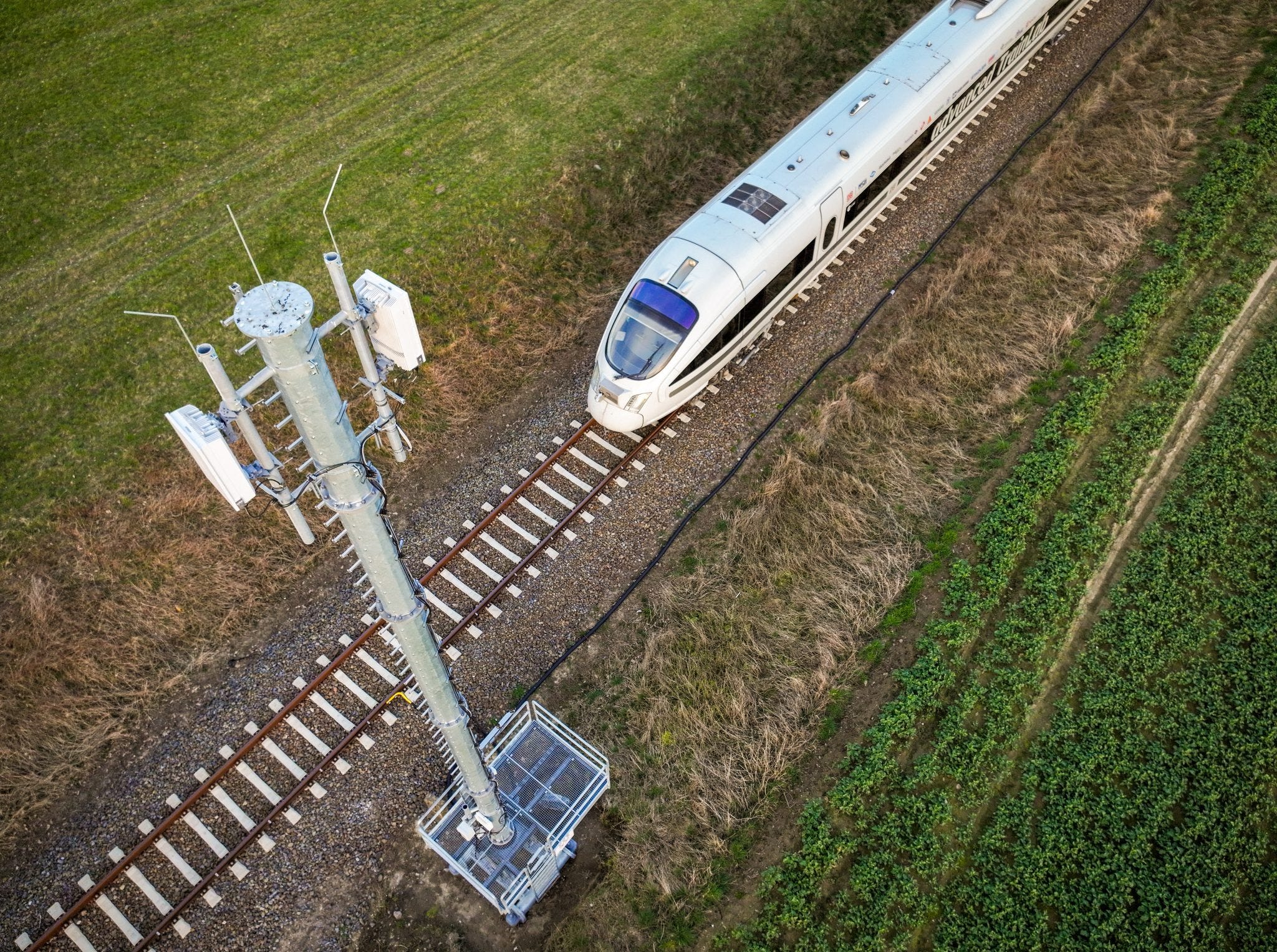
Every train on the European network runs on two conversations at once — one that keeps it safe, and one that keeps its passengers connected — carried over radio systems, onboard networks, and wayside infrastructure that keep the two strictly apart.
The systems behind the two purposes are deliberately kept apart. Safety-critical communication carries train protection data — movement authorities under ETCS Level 2, emergency calls, and driver–controller voice. Here, a lost or delayed message can directly affect train safety.
Safety-critical and non-safety communication
Non-safety communication carries operational data, passenger information, maintenance telemetry, and passenger internet access. Degraded performance here is a service issue, not a safety issue.
The split is enforced architecturally. Safety-critical bearers are standardised and legally mandated through the Technical Specifications for Interoperability; non-safety bearers are operator-specified and procured commercially.
GSM-R – the current radio layer
GSM-R, the Global System for Mobile Communications – Railway, has underpinned ETCS and cross-border interoperability since its rollout across European networks from the late 1990s. It runs on dedicated railway frequencies: 876–880 MHz uplink and 921–925 MHz downlink.
The system provides voice communication between drivers and controllers, the data bearer for ETCS Level 2 movement authorities, and the Railway Emergency Call — a one-button broadcast reaching all trains in a geographic area in under two seconds.
GSM-R covers approximately 130,000 km of track in Europe and more than 200,000 km worldwide. Its limitation is bandwidth: 9.6 kbps of data throughput, enough for ETCS Level 2 movement authority packets but far short of what modern train management, closed-circuit television (CCTV), Automatic Train Operation (ATO), and passenger broadband demand.
The transition to FRMCS
FRMCS, the Future Railway Mobile Communication System, is the successor to GSM-R developed by the International Union of Railways (UIC), based on 5G New Radio and standardised through the 3rd Generation Partnership Project (3GPP). Two pressures drive the transition: vendor support for GSM-R technology is expected to become difficult from around 2030, and railway digitalisation keeps raising bandwidth requirements.
FRMCS uses the existing 900 MHz railway band plus the 1900–1910 MHz unpaired band allocated by the European Conference of Postal and Telecommunications Administrations (CEPT) in November 2020. The higher frequency delivers substantially more bandwidth but needs denser base station deployment — roughly double the number of sites compared with GSM-R at 900 MHz.
Most infrastructure managers are expected to deploy FRMCS in the 1900 MHz band initially while maintaining GSM-R at 900 MHz through a parallel operation phase. GSM-R retires only when the last lines and trains complete migration.
The migration touches both trackside infrastructure and rolling stock. Some European train procurement contracts from 2024 onward already specify FRMCS compatibility.
Deutsche Bahn has run a live FRMCS 1900 MHz network on its own Erzgebirge test line since 2025, with trials on operational lines from 2027. France’s national FRMCS transition is planned for 2028–2035, with commercial rollout from 2032.
At the ERTMS 2024 Conference, SNCF and DB representatives estimated a requirement to retrofit approximately 10,000 vehicles per year to meet the 2035 deadline.
The network inside the train
Communication does not stop at the train exterior. Internally, rolling stock operates a Train Communication Network (TCN), standardised under IEC 61375, which links the Train Control and Management System (TCMS) with doors, heating, ventilation and air conditioning (HVAC), passenger information displays, traction electronics, braking systems, and event recorders.
The original TCN architecture used the Multifunction Vehicle Bus (MVB) within each vehicle and the Wire Train Bus (WTB) between vehicles. Ethernet-based successors — the Ethernet Train Backbone (ETB) and Ethernet Consist Network (ECN), defined in IEC 61375-2-5 and IEC 61375-3-4 respectively — are now specified for new rolling stock.
Segmentation keeps safety-critical and non-safety traffic apart in practice. EN 50159 defines the requirements for safety-related communication in transmission systems, with IEC 62280 as its international equivalent.
A dedicated international cybersecurity standard for rail, IEC 63452, is in preparation; the draft is expected to address the segregation of passenger Wi-Fi from operational control systems once adopted.
Passenger connectivity
Passenger broadband on trains is delivered through mobile network operator agreements or dedicated onboard access points that aggregate cellular signals. Provision is commercially driven by operators rather than mandated by regulation.
The technical challenge is managing handover at speed across multiple mobile networks while sustaining throughput for concurrent users. The problem has eased as Long-Term Evolution (LTE) and, increasingly, 5G coverage along rail corridors improves.
The two layers — safety-critical radio and passenger connectivity — share physical infrastructure in some antenna arrangements. Logically, they remain separated and independently managed.
Go deeper:
Train antennas and multiband systems