

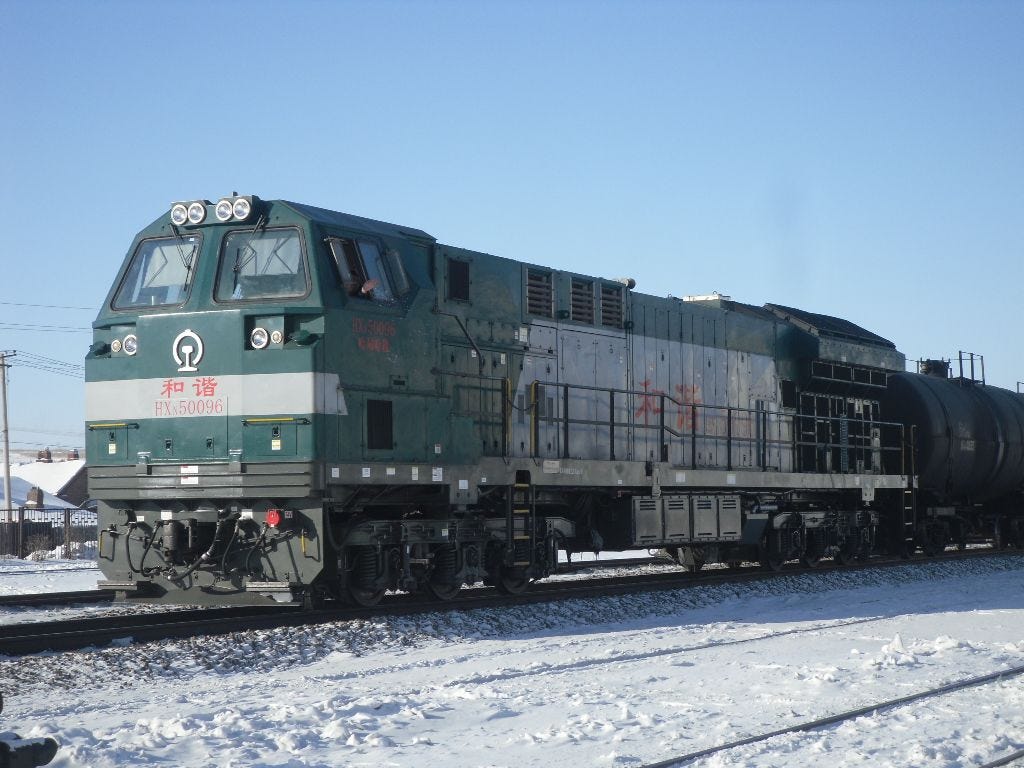
China has carried out a trial in which seven heavy freight trains – together weighing about 35,000 tonnes – ran as one digitally controlled formation without mechanical coupling.
The test took place on the Baoshen Railway in Inner Mongolia and was led by China Shenhua, part of the state-owned group CHN Energy. The trial was first reported by China Central Television (CCTV), which released the key technical details.
How the trial worked
Each train weighed roughly 5,000 tonnes. They remained physically separate, but their acceleration, braking and spacing were synchronised by a software-based control system operating in real time. According to Chinese media citing the CCTV footage, the approach could increase capacity on existing single-track lines by up to 50 per cent without major infrastructure works.
The trial used standard heavy-haul locomotives, identifiable as CRRC’s HXN5 series. The innovation is the operational layer: a wireless group-control system that sits above the trains and coordinates them as a single unit.
A different development path from Europe
The test is relevant for Europe because it highlights a technology path beyond today’s priorities. Digital Automatic Coupling (DAC) focuses on the physical integrity of a single train — coupling, brake lines, power and data. Virtual coupling works on a separate layer, coordinating multiple trains without physical contact.
China is testing this upper layer directly. Europe is building the lower layers first — DAC, ATO over ETCS and FRMCS — before concepts such as virtual coupling can be evaluated within a safety- and standards-driven framework.
New operating models
How far these methods could be applied on European freight corridors will depend on safety cases, interoperability requirements and regulatory approval. But the trial shows how quickly new operating models can be tested in a vertically integrated system with long heavy-haul routes and shorter approval cycles.
Why it matters: China has demonstrated a top-down model for digital control of heavy freight trains — several trains running as one formation without mechanical coupling. Europe is pursuing a bottom-up path, where DAC, ATO and FRMCS first establish the physical and digital backbone. The contrast raises a fundamental question: at what stage, and on which layer, more advanced digital control should be introduced on Europe’s main freight corridors?