

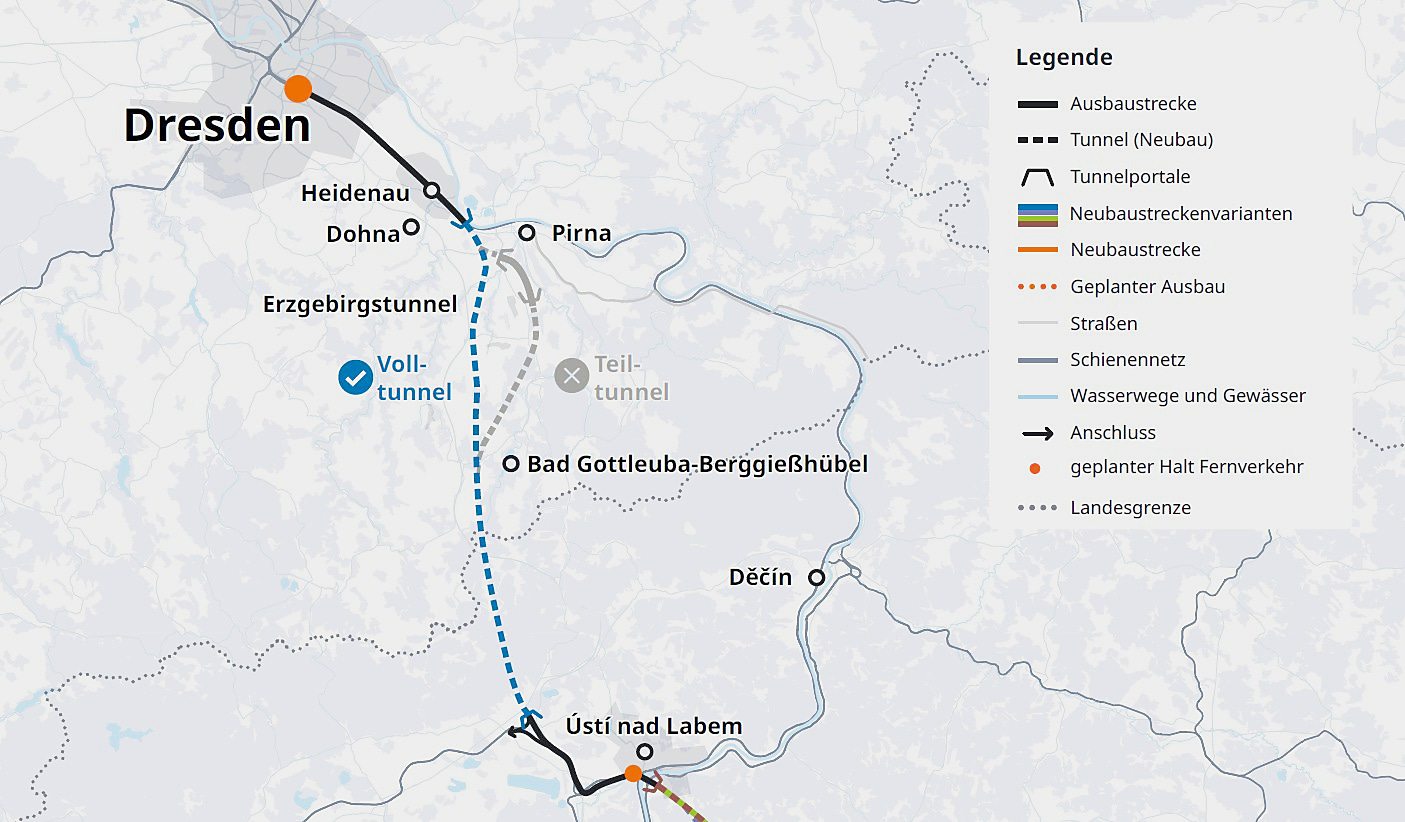
CROSS-BORDER: Germany’s Bundestag has approved detailed planning for a 30-kilometre high-speed tunnel through the Ore Mountains, unlocking a bilateral treaty with Czechia — but with no funding yet secured for construction.
The decision authorises DB InfraGO to proceed with engineering design on the Dresden–Prague new line, which would cut the journey between the two cities from around two and a half hours to one hour on the Berlin–Prague–Vienna corridor.
The decision unblocks the bilateral state treaty with the Czech Republic, which Prague approved in July 2025 and which has been ready for signature on the German side. Signature remains conditional on Germany resolving the budgetary framework — no funding for the project is included in the 2026 federal budget.
Funding gap the next structural hurdle
The Bundestag vote does one thing immediately: it allows DB InfraGO to begin engineering and approval planning, and moves the state treaty with Czechia toward signature. Neither step happens without money.
The 2026 federal budget contains no allocation for the project. Saxony is pushing for EUR 20m in planning funds in the 2027 budget — the minimum required to keep the December 2032 construction start on the table. Without that allocation, the planning phase stalls, the treaty sits unsigned, and the 2032 target slips before ground is broken.
Tunnel chosen over partial route
The Bundestag endorsed the full-tunnel variant: a 30-kilometre bore from Heidenau, south of Dresden, to Chabařovice in Czechia. A partial tunnel alternative was rejected. When built, the Erzgebirge tunnel would be Germany’s longest rail tunnel — around 1.5 times the length of the Fehmarnbelt tunnel currently under construction.
The existing route runs through the Elbe valley — a bottleneck with noise-sensitive single-track sections that constrains both passenger and freight capacity. The new line removes that constraint.
Berlin–Vienna corridor and beyond
The project sits at the centre of the Berlin–Prague–Vienna high-speed corridor and connects to the Orient/East–Med freight corridor linking Hamburg to Athens and beyond.
Total estimated cost is at least EUR 5.6 billion. DB InfraGO is targeting a construction start in December 2032 and opening by the end of 2044 — a timeline that depends entirely on the 2027 budget delivering what Saxony is asking for.