

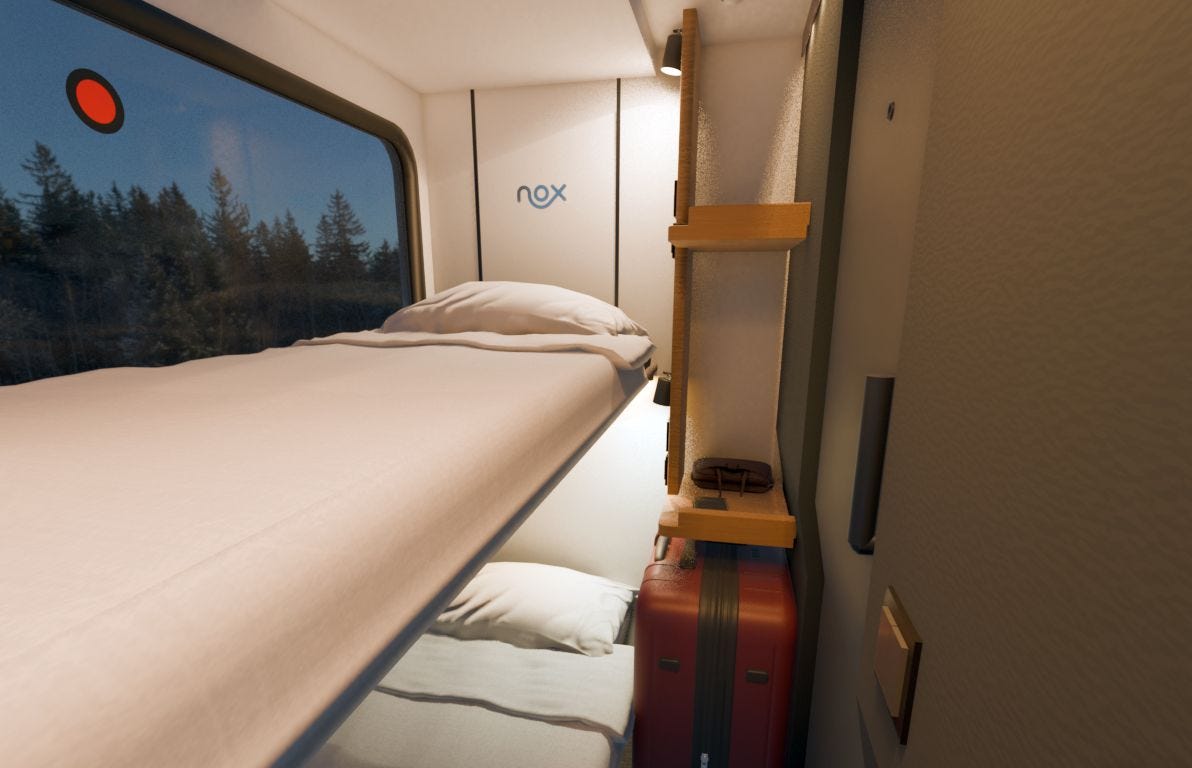
NIGHT TRAINS: Berlin-based Nox Mobility has secured EUR 2m in pre-seed funding to develop a night train concept built around fully private rooms, with first routes planned for 2027.
The round was led by IBB Ventures, the VC arm of Berlin’s public development bank, with participation from Italian investor Tommaso Lucca and HomeToGo co-founder Patrick Andrae. Capital will go toward team expansion, a full-scale cabin mock-up, and first route preparation.
Nox offers three room categories — single loft, double loft, and double vista — with single rooms priced from EUR 79 and double rooms from EUR 149. The company positions the service as a direct alternative to short-haul flights, not as a premium upgrade on existing sleeper trains.
Private rooms as the differentiator
The core commercial logic is that shared compartments are the primary reason night trains fail to retain passengers. Nox’s answer is to give every traveller a lockable private space, removing the barrier that pushes business travellers and solo passengers toward aviation.
Business travellers already account for 30% of night train passengers in France, according to Nox Mobility. Nox is designed with that segment in mind: city-centre departures in the evening, city-centre arrivals the following morning, no airport transfer, no hotel stay.
The founding team reflects the bet. Thibault Constant is a former Alstom and SNCF engineer who built rail media platform Simply Railway to more than 600,000 subscribers. Janek Smalla served as General Manager of Bolt’s German ride-hailing business after operational roles at FlixTrain. Artur Hasselbach co-founded Berlin hospitality payments firm Orderbird.
EUR 2m and what it buys
At pre-seed stage, the capital does not fund operations. It funds proof of concept: a full-scale physical mock-up of the cabin, route analysis, and the team needed to prepare a launch.
Nox will present its first refurbished coach at InnoTrans in Berlin in September 2026. The company has identified up to 35 possible routes across Europe and aims to connect more than 100 cities by 2035, though no specific connections have been confirmed.
The funding lands in a market defined by a structural contradiction. Weekly night train services across Europe fell from around 1,200 in 2001 to approximately 450 in 2019, despite growing demand. New entrants have struggled to convert passenger interest into operational stability, facing path allocation delays, infrastructure constraints, and fragmented cross-border access.
Nox has not yet demonstrated it can navigate those barriers. September 2026 at InnoTrans will be the first public test of whether the concept holds up at scale.