

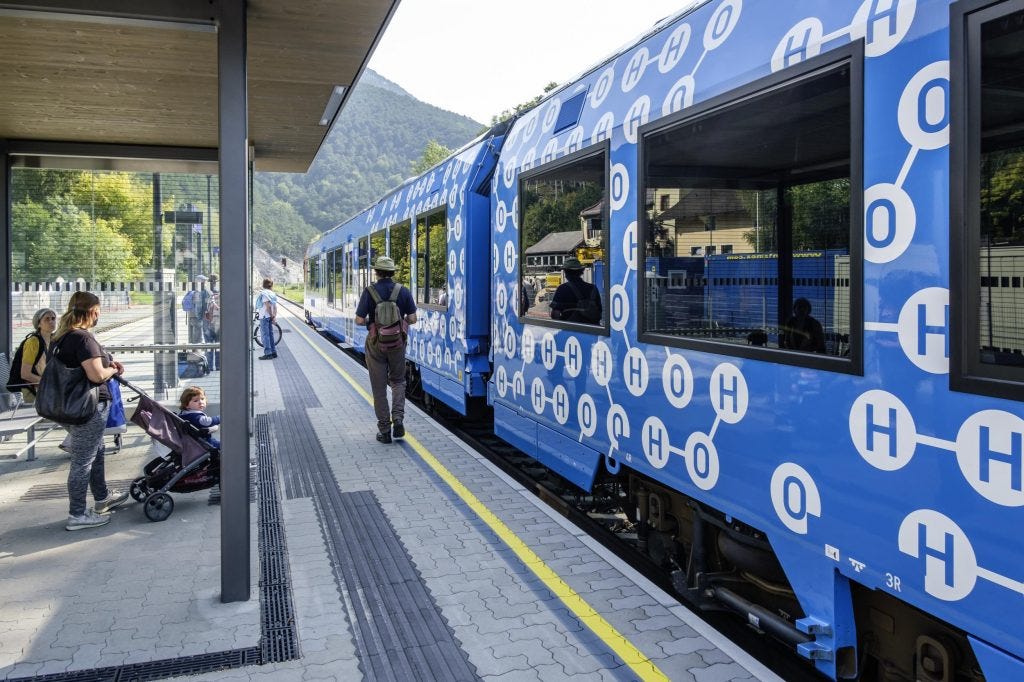
Alstom is putting further development of hydrogen-powered trains on hold, saying the technology is “not yet mature” and pointing directly at the French state for discontinuing key subsidies. The move brings a decade of political enthusiasm for hydrogen rail into sharper focus — and reopens the debate on how Europe should decarbonise its non-electrified lines.
In an interview with BFM Business, Alstom confirmed that several hydrogen development activities have been paused. Existing orders — including regional units in France and Germany — will still be delivered. But further R&D is suspended after what the company describes as a sudden end to public funding.
The decision is notable because hydrogen has long been presented as an alternative for rural and regional routes where electrification is expensive.
In practice, the chain of energy losses and the cost of depot infrastructure have made hydrogen difficult to scale. At the same time, modern battery-electric trains now cover 40–80 km on a single charge, closing much of the gap.
Hydrogen rail at a turning point
Alstom’s move comes at a time when Europe is no longer moving toward one preferred solution. Some operators still see hydrogen as useful on specific, hard-to-electrify routes. Others argue that conventional electrification, supported by battery trains, covers most regional needs.
Many energy and industry specialists now see hydrogen as more relevant for sectors with no practical alternatives — such as steelmaking, chemicals and parts of heavy road transport. The central question is whether the costs add up without subsidies.
Political ambition meets structural limits
France has been one of Europe’s strongest champions of hydrogen rail, driven by regional governments, national strategies and industrial alliances. The pause highlights the limits of this approach: political momentum can launch a programme, but cannot sustain it if the underlying costs remain high.
Reactions are already diverging. Supporters of hydrogen view the pause as a setback for an emerging technology, while advocates of electrification point to it as confirmation that the market is shifting toward simpler, more efficient options.
For policymakers, the announcement forces a reassessment of how public funds should be allocated across different decarbonisation choices.
Why it matters: Hydrogen rail has relied heavily on subsidies, and Alstom’s pause exposes unresolved cost and efficiency challenges.
What’s new: The withdrawal of French public funding has triggered a suspension of further development, while battery and electrification projects continue to advance.
What to watch: How governments respond — and whether hydrogen rail returns if costs fall or remains limited to specific use cases.