

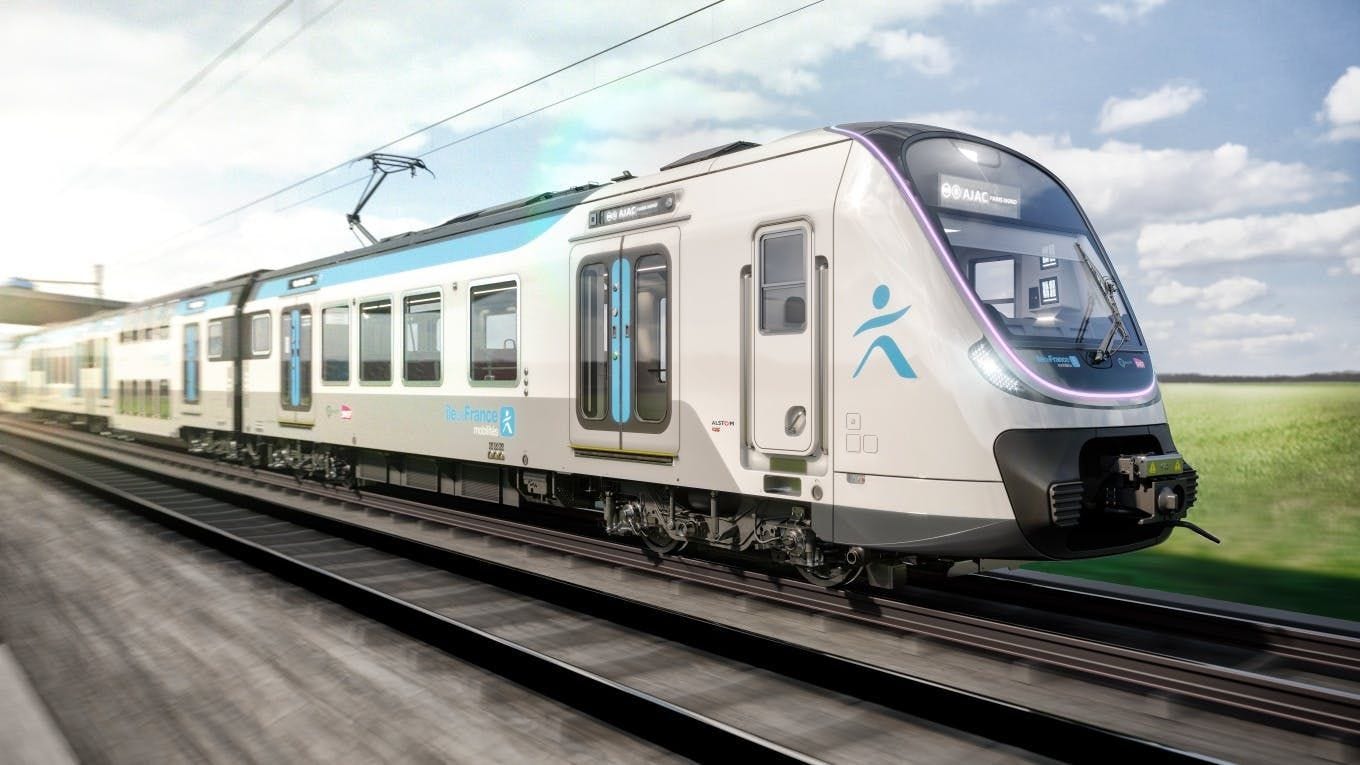
The Alstom–CAF double-deck EMU was built exclusively for RER B — one of Europe’s most demanding commuter environments with more than one million daily passengers.
Paris commuter authority Île-de-France Mobilités commissioned 146 MI20 trainsets in February 2021 under a EUR 2.56 billion contract awarded to an Alstom–CAF consortium.
The first end car left CAF’s Reichshoffen plant on 29 January 2026 and was transported by road to Alstom’s Crespin site in northern France, where final assembly is under way.
Design and capacity
The MI20 is a seven-car hybrid trainset, combining single and double-deck carriages to maximise capacity within the physical constraints of the RER B infrastructure.
Those constraints were decisive. Tunnel clearances on the southern section of the line — built in the nineteenth century as the Ligne de Sceaux — ruled out the 112-metre length used on RER A. Platform lengths and signalling positions set further limits, leaving a design envelope the consortium had to engineer around, not adapt an existing product to.
Each trainset carries 1,070 passengers, 345 of them seated. That is around 35 percent more capacity than the current MI79 and MI84 fleet, which carries 788 passengers per trainset. Each unit is equipped with full-length intercirculation, air conditioning and level boarding designed to cut dwell times at busy central Paris stations.
A line with two operators
RER B is structurally unlike most European commuter lines. North of Gare du Nord, SNCF Voyageurs operates the service. South of that station, RATP takes over. The MI20 must function seamlessly across both operating domains — a requirement that shaped the train’s systems architecture and added complexity to the certification process.
This dual-operator structure also explains why RER B has historically been harder to upgrade than comparable lines. Any change to rolling stock, signalling or infrastructure must satisfy two separate operating organisations with different technical standards and procurement cultures.
Production and timeline
Assembly of the MI20 is split between two manufacturers. CAF produces the end cars at its Reichshoffen plant in Alsace, while Alstom manufactures the central cars and carries out final assembly at its Crespin site in northern France. No complete trainset has yet been built.
The programme has experienced repeated delays. Service entry was originally planned for 2025. The current target, confirmed under an emergency action plan agreed between IDFM and Alstom in September 2025, is late 2028 for the first trainsets in passenger service. Full delivery of all 146 units is not expected before 2030.
What changes when the MI20 arrives
The capacity gain is significant, but the deeper system change on RER B depends on the synchronisation of the MI20 fleet with NExTEO — the communications-based train control system being deployed across lines B and D.
NExTEO will allow headways in the shared central tunnel between Gare du Nord and Châtelet–Les Halles to be reduced substantially, increasing the number of trains that can run through the core of the network per hour. Each MI20 trainset will carry the onboard NExTEO equipment under a separate EUR 239 million contract funded by IDFM.
The central tunnel section is scheduled to go live with NExTEO in 2031, with full deployment across the RER B perimeter by 2033. Infrastructure works already under way in 2026 — including electrical reinforcement and platform adaptations — are designed to prepare the line for the heavier and more technologically complex trainsets. The MI20 and NExTEO together represent the most significant operational transformation of RER B since the line’s current configuration was established.