

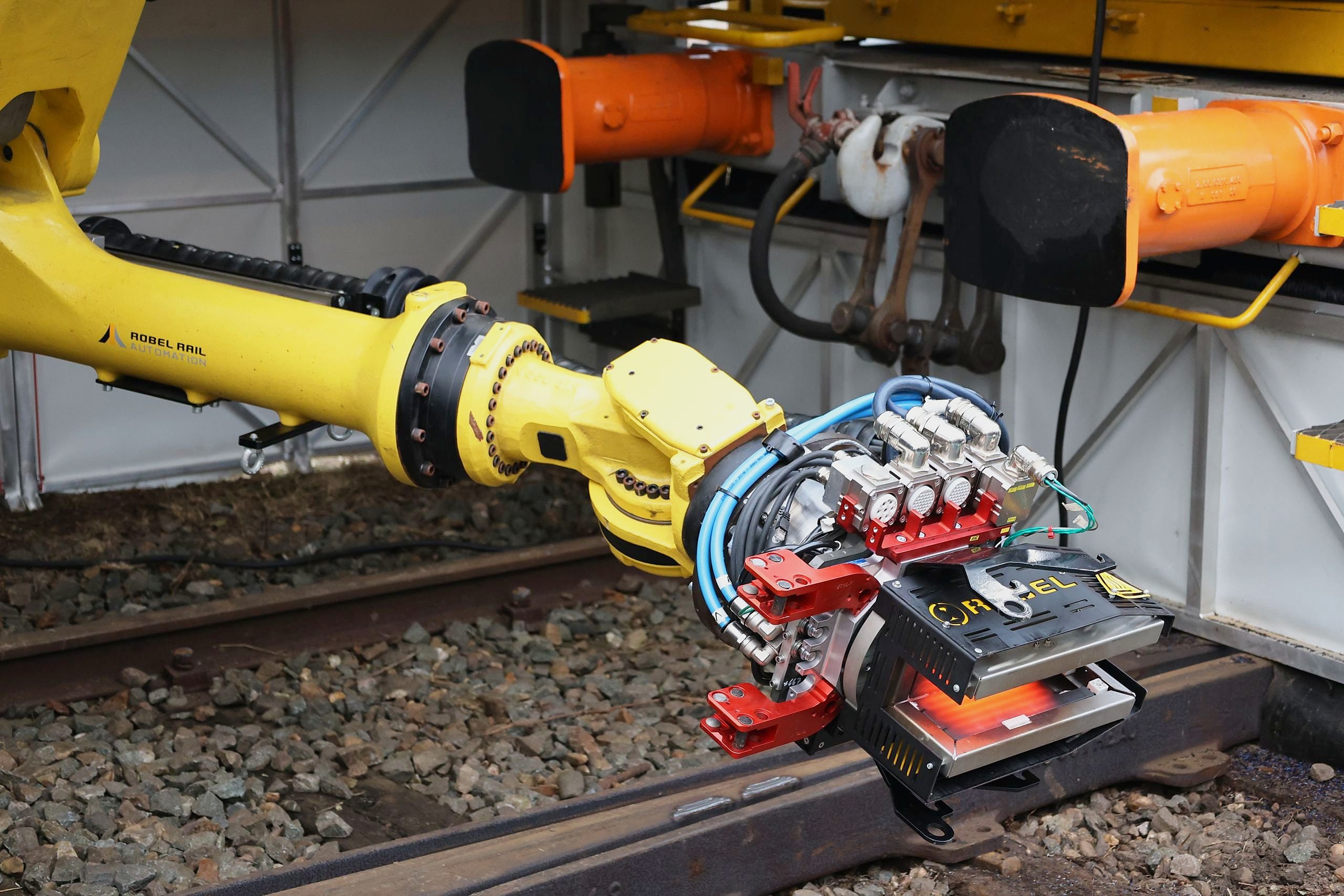
A small technology unit inside one of Europe’s largest railway machinery groups is building robotic systems for track inspection, switch welding and component restoration — and has a live project running on the Dutch rail network.
ROBEL Rail Automation GmbH is based in Freilassing in Bavaria, a few kilometres from the Austrian border. It operates as part of ROBEL Group, a Bavarian machinery group that has built track maintenance equipment since 1901. The automation unit is a separate entity with its own product development, its own engineering team and a distinct commercial identity.
The company builds three systems. Robot is a welding platform mounted in a container on a standard rail wagon. It scans the rail, mills the defect, preheats, welds and grinds — end-to-end, with one operator supervising the process.
Rospect is a modular inspection and measurement platform that integrates different sensing technologies and feeds the output into the customer’s existing data infrastructure. Rocenter is a workshop system for the automated restoration of worn switch components, combining scanning, milling, welding and reprofiling in a single cell.
Robot: from laboratory to network
The most developed of the three is Robot. ROBEL Rail Automation has completed preliminary homologation of its welding process for R260Mn rails under ISO 15594 and RLN00451-2, and has achieved provisional homologation for manganese switch frogs.
The system is being developed for deployment on the Dutch rail network in partnership with ProRail, Strukton Rail and VolkerRail. In November 2024, the four parties held two days of demonstrations at Railcenter in Amersfoort — six welding demonstrations and six workshops, with 160 participants from across the Dutch rail sector.
In May 2025, the four parties signed a memorandum of understanding at the IAF trade fair in Münster, committing to further development of the system for the Dutch network. Eight welds carried out at the Maasvlakte port complex have been monitored for close to a year. Strukton describes the results as promising. No deployment timeline has been confirmed.
The problem the robot is built to solve
The Netherlands has around 100 qualified rail welders. The work is physically demanding, carried out at night, in all weather conditions, with precision requirements that leave little room for fatigue. Fewer people are choosing it.
“The robot does not make mistakes, does not get tired and can work with millimetre accuracy, always and under all circumstances,” said Jeroen Mulder of VolkerRail at the Amersfoort demonstrations.
The Robot system addresses the constraint directly. It operates during night possession windows, in rain and cold, without rest, and produces digitally documented results for each weld. A single operator supervises the process.
Rocenter and the next generation
Rocenter targets a parallel problem: worn switch components that would otherwise be scrapped. The system restores them in a workshop cell, reducing milling times by up to 75% and preheating times by up to 50%, across a processing area of up to 8 by 3.5 metres. It handles rail materials from R200 to R400HT and manganese steel.
ROBEL Rail Automation is also developing Rofactory, a next-generation switch maintenance system with an extended working range of up to seven metres, designed for repair welding and full geometric reprofiling of switch components. The system uses a container wagon format and a modular machine concept intended to adapt across different network configurations.
The company presented its work at InnoTrans in Berlin in 2022 and at the IAF infrastructure trade fair in Münster the same year. InnoTrans returns to Berlin in September 2026.